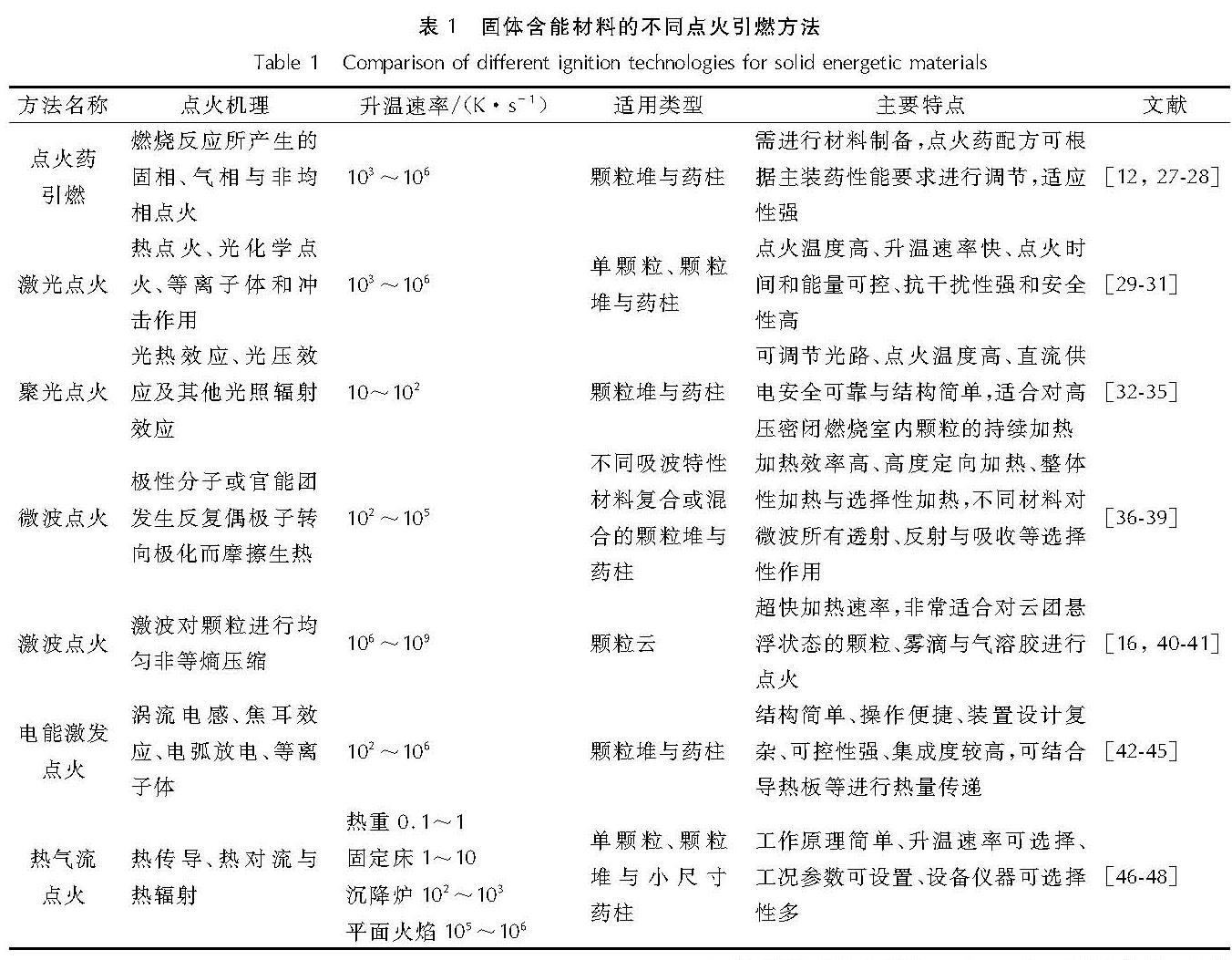
2.1 基于化学能引燃的点火引燃技术
点火药引燃技术是目前固体含能材料工程化应用最为广泛的一类点火引燃技术,其是在外界初始激励作用下,通过快速燃烧化学反应释放出大量的热、气体和灼热的固体残渣,进而引燃火药、炸药与固体推进剂等其他含能材料[23]。点火药在性能上需保证产生足够的熔融态固体颗粒与适当程度的高温高压气体两方面的技术要求[12]。点火药对主装含能材料的点传火过程是基于燃烧化学反应与热传递的点火引燃过程,根据点传火过程的不同,可将该类技术的点火机理分为固相热点火、气相点火与非均相点火3种理论[24]。该方法具有需进行材料制备,点火药配方可根据主装药性能要求进行调节与适应性强等特点。
根据主装药的点火性能要求不同,可将点火药划分为常规点火药与高能点火药。其中,黑火药在人类历史中被长期应用,也是目前武器军用与民用烟花中广泛采用的点火药。高能点火药常被用于钝感或难以点火的固体推进剂,包括硼/硝酸钾(B/KNO3)、镁/聚四氟乙烯(Mg/PTFE)、硅/四氧化三铅(Si/Pb3O4)和钛/高氯酸钾(Ti/KClO4)等混合药剂[25]。
土耳其ROKETSAN导弹火箭中心的Koc等[26]研究了硼颗粒粒度对B/KNO3点火药性能的影响。结果表明,与含微米硼的点火药性能相比,含纳米硼的点火药具有更高的燃烧热值与增压速率,且点火药本身的点火延迟时间更短,但相对应的机械感度更高,并且对峰值压力影响并不显著。
美国陆军武器研究发展工程中心的Rozumov等[49]针对火炮枪械系统的点火药进行了研发,其将奔奈药与硝化纤维/硼/硝酸钾(NC/B/KNO3)进行了对比试验。结果表明,NC/B/KNO3具有更短的压力峰值时间,并且点火延迟时间与输出能量具有很好的改善。
南京理工大学的邓寒玉等[50]研究了真空环境下黑火药对固体火箭发动机的点火性能,其将阵列式固体火箭发动机放置于真空罐中,测试获取了不同点火位置和黑火药质量下的点火压力曲线和羽流情况。结果表明,对于前段点火试验样机,不同黑火药质量下到达压强峰值的时间均为5ms左右,而对于尾部点火试验样机,压强峰值时间受黑火药质量影响较大; 真空环境下,试验样机的点火燃气流量不稳定导致羽流扩张角出现明显波动,即黑火药呈现不稳定燃烧。
航天动力技术研究院的王金华等[27]采用黑火药作为点火药对多个型号的双基推进剂固体火箭发动机进行了点火试验研究,其采用传统经验公式计算点火药质量,并设计了图1所示的点火器结构。结果表明,传统经验公式适用于常规发动机,而对于小型固体火箭发动机,应将能量损失系数修正为0.7以改善固体火箭发动机点火性能。
图1 用于固体火箭发动机的点火器[27]
Fig.1 Schematic diagram of igniter used for solid rocket motor
北京理工大学的焦清介等[51]探究了铝锰合金点火药的燃烧性能与安定性,其将金属粉的活化能作为点火性能判据,结果表明,铝锰合金粉活化能比相同粒度铝粉低14.4kJ/mol,即前者更易着火; 与锰粉点火药相比,铝锰合金点火药的燃烧峰压、增压速率和平均质量燃速更高,即该种点火药的性能最为优异。
沈阳理工大学的梁杰等[52]针对含金属粉点火药的吸湿性进行了研究,其测试了分别含镁、铝和锆3种金属粉点火药的吸湿率,并在密闭爆发器内测试了潮湿环境中3种点火药的压力特性。结果表明,镁点火药会受到潮湿环境的严重影响,潮湿环境下点火燃烧压力下降89%~94%; 锆点火药和铝点火药吸湿不明显,潮湿环境下压力分别下降5.6%~11.4%与0.2%~5%。
根据上述研究报道,基于点火药的点火引燃是目前实际应用中一种重要的点火方法。可以看出,相关研究主要集中在对点火药配方进行设计优化,使得压力峰值时间缩短、输出能量特性提高以及使用储存更加安全可靠等方面,即高能钝感是点火药发展的主要方向。然而,实际应用时,点火药的性能、配方以及质量等都偏向于传统经验公式,缺乏可直接用于设计选型的系统数据库,同时缺乏从点传火机理上对主装药点火过程的精准控制。因而,未来有必要针对高能低感点火药进一步开展系统研究以提高点火药设计水准与实现引燃过程的定量准确控制。
2.2 基于光能激发的点火引燃技术
2.2.1 激光点火
激光点火也是目前应用广泛且发展潜力巨大的一类固体含能材料点火引燃技术,具有点火温度高、升温速率快、点火时间和能量可控、抗干扰能力强和安全性高等特点。激光点火是将受激辐射放大的激光能量作为点源或者线性源作用在固体颗粒表面,以平移、转动或者振动等单一或多种方式增加颗粒表面的动力学能量,从而使颗粒中的分子键断裂或发生化学反应,进而引发着火燃烧的一种技术手段[53]。
根据激光与固体燃料相互作用的机理不同,可以将激光点火机理分为激光热电火、激光诱导光化学点火、激光诱导等离子体点火与激光的冲击起爆作用等[29],以固体含能材料为主的固体燃料激光点火机理为热电火,光化学作用要求材料对激光波长具有很强选择性,等离子体点火要求激光功率密度达到约1010W/cm2的气体等离子体击穿阈值[54]。
20世纪60年代中期,美国能源部、美国喷气推进实验室、瑞典国防研究局等率先开展激光点火与激光起爆的技术研究[9],其目的就是要取代传统的热电阻与雷管引爆技术,以实现对武器安全性能的要求。现有用于固体燃料颗粒的激光器包括固体激光器、半导体激光器和气体激光器,其中固体激光器有Nd:YAG激光器,其输出功率可达250MW且适用于炸药的点火起爆研究; 半导体激光器包括二极管激光器(Laser diodes,简称LD)和发光二极管激光器(LED激光器),出光功率可实现0.5~50W且光束质量高,适用于烟火药和推进剂的点火研究; 目前应用最为广泛的气体激光器包括CO2激光器和氦氖激光器等,由于价格低、结构简单且可长时间稳定运行,功率通常为0.5mW~50W,常用于实验室中对固体含能材料的研究[55]。此外,根据工作状态的不同,可以将激光器划分为连续激光器和脉冲激光器,前者可在较长时间内稳定持续输出,并且激光激励过程中各能级粒子数和辐射场均保持稳定分布,而后者单个激光脉冲宽度小于0.25s且间隔输出,通常具有较大输出功率[56]。
固体含能材料点火引燃的基础研究已有大量文献报道。Brish等[57]较早于1969年对采用激光引燃和起爆黑索今(RDX)和奥克托今(HMX)等含能材料的点火爆炸反应机理进行了分析。美国海军空战中心的Gross等[20]针对HMX激光点火过程建立了瞬态与稳态一维数值模型,其假设瞬态模型中点火过程发生于气相部分并在火焰产生后回传至HMX表面,即点火时存在“火焰反弹效应”,并考虑了凝聚相的辐射传热、固相熔融、汽化蒸发和半全局分解动力学,最终模拟值与实验数据比较具有较好的一致性。
美国新泽西理工学院的Mohan和Dreizin等[30, 58]对微米级多分散含铝颗粒气溶胶的激光点火过程进行了理论计算、数值模拟与实验研究。图2所示为所采用的激光点火实验平台,主要包括了升温速率为106K/s的CO2激光器和用于实现气溶胶雾化的平行板电容器。结果表明,激光光束与微细颗粒之间的相互作用取决于颗粒尺寸,当金属颗粒粒径约为3.37μm时,金属颗粒与激光的相互作用最为强烈。同时,其考虑热平衡和简化化学反应动力学模型,获取了不同氧化气氛和不同气体流速下金属铝单颗粒的激光点火功率阈值和放热反应的Arrhenius动力学参数。
图2 多分散含铝颗粒气溶胶的激光点火实验平台[58]
Fig.2 Experimental platform of laser ignition for polydisperse aluminum-containing aerosol
法国国家科学研究中心的Shafirovich和Sarou-Kanian等[59-61]分别将激光点火与电动悬浮相结合,研究了粒径为微米级别呈单颗粒状态的铝颗粒、镁颗粒、钛颗粒和镍包覆铝颗粒等金属颗粒的点火燃烧特性,结果发现镁颗粒在CO2气氛中的激光点火引燃行为存在明显的临界分压,而铝颗粒在CO2气氛中点火概率低且点火燃烧行为与压力无关。此外,镍包覆铝颗粒的表面包覆层可以显著降低激光加热铝颗粒的点火延迟时间和铝颗粒引燃时的临界点火温度。
北京理工大学的石保禄等[15]研究了亚稳态分子间复合物(MIC)的激光点火行为,结果发现对于表面包覆镍和磷双涂层的微米铝颗粒,较高磷含量的MIC材料在复合推进剂中具有较短的点火延迟时间。
杭州电子科技大学的黄雪峰等[62-64]采用激光点火结合光悬浮技术,研究了微纳米尺度呈单颗粒状态的碳粉、铝颗粒、镁颗粒和铝镁锆合金颗粒等固体燃料颗粒的点火燃烧特性,结果发现,悬浮静止空气流状态下,碳粉点火功率约为9.0mW且点火延迟时间为ms量级,而纳米铝颗粒点火功率约为28.7mW且点火延迟时间为μs量级。
浙江大学的苑继飞等[65]采用功率连续可调CO2激光器开展了Al/AP/HTPB复合固体推进剂的点火燃烧实验,研究了铝颗粒在近燃面区域的团聚形态与过程。图3所示为激光点火系统的示意图和实物照片。结果表明,铝颗粒在固体推进剂燃面形成团聚体的过程包括堆积、聚集和团聚3个阶段; 烧结铝液滴在燃烧表面会发生破裂并喷出液态氧化铝,这表明团聚体具有非均质组成特征; 所统计400个铝颗粒团聚体的粒径范围为51~815μm,所统计176个铝颗粒团聚体的速度范围为13~196cm/s,同时团聚体的移动速度随粒径的增大而逐渐减小。
图3 用于固体推进剂颗粒燃烧的激光点火实验系统示意图和实物照片[65]
Fig.3 Schematic diagram and photo of the laser ignition platform for solid propellant
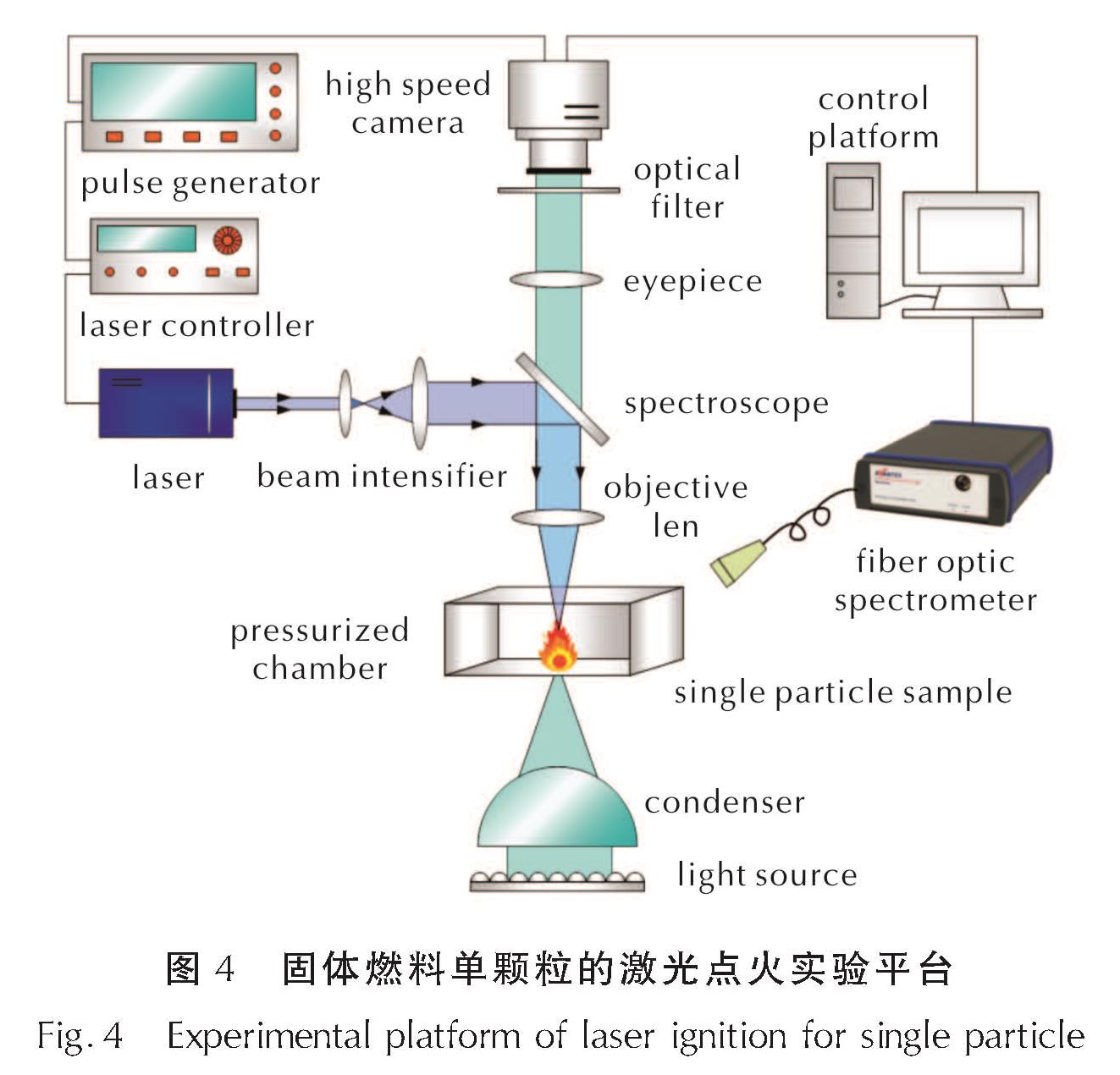
西安近代化学研究所的赵凤起等[66]研究了两种金属有机骨架材料(MOFs)对单质含能材料六硝基六氮杂异伍兹烷(CL-20)的激光点火和火焰传播特征,结果发现这两种MOFs可以有效降低CL-20点火功率阈值和点火延迟时间,并且火焰变得更为明亮。此外,国内西安近代化学研究所也针对固体燃料单颗粒搭建了如图4所示的激光点火实验平台,重点针对以含能材料为主的固体燃料单颗粒开展深入研究。
根据上述研究进展,可以看出,激光点火在固体含能材料领域已展开了广泛且深入的研究工作,国外激光点火应用较早,而国内相关研究起步较晚但发展迅速。目前,激光点火已在单颗粒、颗粒堆与药柱等多种材料堆积形态开展了相关研究。该类技术已成为固体含能材料点火燃烧特性研究的常用方法,并且激光点火技术正朝着小型化光源、大功率光源、脉冲激光与多点激光点火等方向发展。此外,目前国内仍然缺乏含能材料单颗粒的激光点火实验研究、含能材料激光点火燃烧模型构建以及多种激光诱导点火机制共同作用机理研究等方面内容,后续工作可着重考虑这些问题以使含能材料的激光点火研究更加深入。
图4 固体燃料单颗粒的激光点火实验平台
Fig.4 Experimental platform of laser ignition for single particle
2.2.2 聚光点火
聚光点火是将功率较大或瞬时功率极强的氙气灯等光源作为点火热源,同时通过光的几何特性进行传输和聚焦,进而实现固体含能材料着火引燃的一种技术手段,因而也被称之为光热点火或氙灯点火。该类技术具有可调节光路、点火温度高、直流供电安全可靠与结构简单的特点,适合对高压密闭燃烧室内固体燃料颗粒的持续加热[67]。根据氙灯光源特性,可以分为长弧氙灯、超高压短弧氙灯和脉冲氙灯,其中脉冲氙灯可实现极强的瞬时功率,其瞬时亮度可达1010~1011cd/m2,是目前除激光外的最亮光源[32]。
目前,聚光点火在以固体含能材料为主的固体燃料方面已有较多报道。国外更多关注特定固体材料在不同辐射波长下的光敏特性或光诱导反应特性所导致的点火现象。2002年,美国伦斯勒理工学院的Ajayan等[68]首先发现了单壁碳纳米管在闪光灯下发生点火现象。意大利萨伦托大学的Visconti等[69-70]采用氙灯闪光点火方式对含金属纳米颗粒的碳纳米管进行了光诱导点火特性的实验研究,并提出了光子吸收与电子转移使材料发生自由基氧化反应,进而发生点火燃烧的物理化学解释。
美国普渡大学的Uhlenhake等[71]采用氙灯闪光点火系统对纳米铝颗粒与聚偏氟乙烯构成的薄膜材料进行了点火特性研究,结果表明,纳米铝颗粒的装载量是控制点火能量阈值的主导因素; 当纳米铝颗粒质量分数为20%~25%时,所构成的薄膜材料具有最低的点火能量,最小的氙灯点火能量为4.7J/cm2。
而国内更加关注聚光辐射所产生的光热效应对不同固体含能材料点火燃烧特性的影响。浙江大学的刘建忠等[72]采用聚光升温点火实验平台研究了0.1~1.3MPa压力条件下呈颗粒堆形态的铝粉与RDX机械混合物的点火燃烧特性,结果发现,较高的压力有利于提高样品的燃烧强度,但过高的压力会限制燃烧火焰形貌的发展; 当压力由常压上升至1.3MPa时,点火延迟时间由1004ms缩短至319.2ms; 当压力从0.4MPa升高至1.3MPa时,自维持燃烧时间由733.6ms缩短至560.8ms。
西安交通大学的闫治宇等[73]基于聚光点火平台研究了含能材料RDX以颗粒堆形态堆积时的点火燃烧过程以及NO、OH等基团浓度变化,结果表明,RDX的点火延迟时间为16.735s,而燃烧持续时间为355ms; 整个RDX反应过程分为吸热、蒸发分解、着火燃烧及反应结束4个阶段,而NO存在明显的两阶段生成规律,分别对应热分解过程与燃烧过程。
西安近代化学研究所的王晓峰等[34]研究了含能材料1,1'-二羟基-5,5'-联四唑二羟胺盐(TKX-50)在聚光作用下的点火反应特性,结果发现,TKX-50整个燃烧反应持续时间约为5.5s,经历热解、点火燃烧与反应结束3个阶段; TKX-50在点火燃烧阶段直接由固相转变为气相,并且火焰发出耀眼的橘黄色亮光,这与传统含能材料RDX和AP等在热解阶段所发生固液熔融相变存在明显区别。
国防科技大学的夏智勋等[33, 74-75]采用球型短弧氙灯点火加热系统对硼颗粒、镁颗粒和凝胶液滴等颗粒堆和大粒径单液滴开展了点火与燃烧过程的实验与机理研究,所采用的氙灯光束聚焦后可实现形成30mm光斑且升温速率可达到500K/s,其建立了考虑斯蒂芬流和聚光点火的一维硼颗粒点火模型与考虑氧化层受力平衡和CO2气氛的镁颗粒点火模型。研究结果表明,聚团硼颗粒的点火温度比单颗粒硼低; 采用镁粉方式可以使聚团硼颗粒的点火延迟时间缩短,但对硼颗粒的点火温度影响不大; 采用光强匹配方法解决了燃烧过程中高光强难以观测的问题,并清晰观察到CO2气氛中镁颗粒点火燃烧过程中发生的氧化层破裂后愈合、颗粒表面氧化物沉积、喷射火焰以及氧化层出现裂痕等典型现象。
此外,聚光点火在煤炭等固体燃料方面也有重要应用。华中科技大学的李寒剑和胡松等[35, 76-77]利用聚光点火技术对压型煤颗粒和压型生物质颗粒进行了点火燃烧特性研究。图5为其搭建的聚光光热燃烧实验系统,该系统整体设计为密封加压腔室结构,采用高功率卤钨灯作为热源,配置有称重模块、测温模块和配气模块。研究结果表明,该实验系统可实现4.0~69.4K/s宽范围升温速率调节; 随着升温速率的增加,煤颗粒的着火机理将由异相着火转化为均相-异相着火,当升温速率达到52.4K/s时进一步转化为均相着火; 煤颗粒的点火延迟时间与固相区温度、煤种、气相区温度和氧浓度满足数学方程关系。
基于上述研究情况,聚光点火已经在包括碳纳米材料、单质含能材料、MIC、金属颗粒等固体含能材料以及煤炭等固体燃料中有所应用,国内外对该类技术的侧重点有所不同,相比国外更多关注光敏材料的研发,国内利用聚光点火的光热效应在固体含能材料点火燃烧的基础研究方面更为深入。聚光点火可以模拟实际环境中颗粒受到强光辐照的安全阈值特性,同时可通过改变光路来获取连续光谱进行加热点火,但目前该类技术因焦点较大且亮度掩盖燃烧火焰等原因尚未应用于微纳米尺度的单颗粒,同时在点火燃烧机理方面仍然缺少光压效应、光热效应以及其他因光照辐射效应等耦合作用的分析报道。
图5 聚光光热燃烧实验系统:(a)示意图;(b)聚光点火反应器;(c)温度测点[76]
Fig.5 Experimental platform of concentrating photothermal ignition: (a)schematic diagram;(b)spotlight ignition reactor;(c)temperature measurement point
2.3 基于电磁波的点火引燃技术
微波点火是通过频率300MHz~300GHz或波长1mm~1m电磁波对固体含能材料进行加热,并根据不同材料对微波所具有的透射、反射与吸收等选择性作用,使物质内部或表面升温进而实现点火燃烧的技术手段[78]。微波在现代社会中常用于通信系统和食品工程,而微波点火主要利用微波的热效应、穿透性和选择性加热等特性对固体含能材料进行升温点火,该类技术具有加热效率高、高度定向加热、整体性加热与选择性加热等优异特性。图6为微波加热原理,即材料内部的极性分子或官能团在微波高频电场作用下发生每秒数十亿次的反复偶极子转向极化而摩擦生热[36],其中水、碳材料等可吸收微波,玻璃、塑料、陶瓷等可使微波穿透,金属等可使微波发射而使加热通常发生于金属表面[39]。
国外针对微波加热与点火方面的研究开展较早,并且针对微波点火的技术设计与点火机理研究较为系统。三硝基甲苯(TNT)等单质含能材料对微波呈透射作用,通常在其中加入碳材料作为吸波材料以强化单质含能材料的微波点火特性。德州理工大学的Pantoys等[38]研究了碳纳米管、球形碳粉、纳米金刚石颗粒、片状纳米石墨烯和片状微米石墨烯等5种碳添加剂与TNT构成复合材料后对微波吸收特性的影响。实验时将各种添加剂按照质量分数1%与TNT进行复合,并采用微波谐振腔体将混合材料完全暴露在1.7GHz微波中60s。结果表明,碳材料壳体形状对微波加热具有重要影响,其中球形碳粉几乎没有吸波受热,而管状和片状碳颗粒吸收微波能量后引起了TNT基材的熔化; 纳米厚度的片状石墨烯具有更好的热传导性,有效增强了复合材料整体的传热效果。
图6 微波点火对材料进行整体性加热与选择性加热[79]
Fig.6 Principle of integral and selective heating of microwave ignition
金属颗粒具有导电性,但同时对微波呈现反射特性,将金属与非金属相结合形成复合材料可以改善材料的吸波性能,因而采用微波点火方式对MIC进行点火燃烧是目前研究的热点。以色列特拉维夫大学的Jerby和Meir[37]基于约100W低功率微型固体微波钻开展了铝热剂Al/Fe3O4的局部点火实验,并探究了点火过程中的热-电磁耦合相互作用机理,结果发现,铝热剂在微波3s连续发射情况下实现了点火,显著缩短了铝热剂的点火作用时间。
美国加州大学河滨分校的Zachariah等[80-81]基于微波点火探针和金属3D打印开展了纳米钛颗粒对纳米铝热剂Al/PVDF的局部微波点火实验,并研究了含纳米钛复合材料的点火机理,其采用喷墨直写技术将纳米钛和纳米铝分别与PVDF复合形成Ti/PVDF和Al/PVDF薄膜,采用微波点火探针对薄膜材料进行点火,微波频率为2.45GHz且功率为15W。如图7所示,结果表明Al/PVDF薄膜暴露于微波下30s无法被点燃,而微波可轻易点燃纳米钛颗粒与质量分数约为65%的Ti/PVDF薄膜; Ti/PDVF复合材料在微波辐射下的点火是由加热速率和燃烧反应动力学控制的,同时温度的升高对该材料的点火延迟时间并无影响。
国内在微波点火技术方面也逐步开展了相应研究并将该种点火引燃方法应用于固体含能材料。电子科技大学的岳亚楠和涂兆正等[82-83]分别对含能材料的微波点火装置开展了研发工作,前者考虑到黑火药的介电常数较低即吸波性能较差,因而设计微波腔体内小锥台结构,进而有效增强电场强度并降低腔体击穿阈值,后者基于微波的同轴谐振原理设计了3款用于点火的腔体结构,分别为无探针、单探针和多探针结构,以满足整体加热、单点点火和多点点火的需求。
图7 微波点火探针作用于Al/PVDF和Ti/PVDF薄膜后的点火效果[81]
Fig.7 Effects of microwave ignition probe on Al/PVDF films and Ti/PVDF films
此外,微波点火也可用于煤炭颗粒的点火燃烧。哈尔滨工业大学的赵广播和周伟等[84-86]采用微波点火方式对无烟煤等低挥发分煤种进行了实验研究与数值模拟,其采用腔体型反应器对固体燃料颗粒进行加热点火。结果表明,微波诱导等离子体放电点火的燃烧产物中CO2所占比例明显高于与单独采用微波点火方式后燃烧产物中CO2比例,前者为84.6%而后者为73.2%,表明微波诱导等离子体点火方式比单独微波点火方式能够更有效促进无烟煤完全燃烧。
根据上述研究进展可以看出,随着吸波材料和点火系统的不断研发,微波点火已逐渐在MIC、含碳含能材料和煤炭等固体燃料方面进行了应用。国外对微波点火在固体含能材料方面的基础研究更为全面且深入,而国内在微波点火装置研发、吸波材料制备与表征以及含能材料的微波点火基础研究方面仍然研究较少。此外,除直接加热物体以外,微波还具有诱导产生等离子的作用,通过等离子体方式对固体含能材料点火也是微波点火技术的重要组成部分,这种诱导产生等离子体进而引燃固体含能材料的方式是否对燃烧效率与点火性能等有所改善,这方面也值得深入探讨研究。
2.4 基于高压冲击波的点火引燃技术
激波点火,亦称为激波管点火或冲击波点火,是采用激波管装置通过高压气体膨胀做功方式,通过入射激波和反射激波对反应介质进行均匀非等熵压缩,使固体含能材料在瞬间受到高温高压气体冲击进而发生点火引燃。激波点火是研究以固体含能材料为主的固体燃料颗粒在冲击波和爆轰过程中能量传递及点火燃烧特性的一类重要技术手段[87]。图8为典型的可用于固体颗粒、雾滴及气溶胶等的激波管实验平台。该装置由高压驱动气体段和低压从动气体段两部分组成,中间采用聚酯薄膜隔开,同时低压从动气体段端部放置有待点火燃烧的固体含能材料及布置有相应的压力测量与高速摄像等测量部件; 当薄膜在高压气体挤压下发生破裂,高压气体瞬间膨胀到达激波管端部,引起固体含能材料快速升温进而发生点火燃烧。激波点火的特点是具有超快加热速率[40],非常适合对云团悬浮状态的颗粒、雾滴与气溶胶进行点火引燃,可用于探究云爆弹的燃烧传递[88]、粉末冲压发动机喷管处燃烧[41]以及再入飞行器的材料热蚀特性[89]等军事和航天领域的固体含能材料点火燃烧特性。
图8 固体燃料颗粒激波点火实验系统示意图[16]
Fig.8 Experimental platform of shock wave ignition for solid fuel particles
目前,激波点火在固体含能材料基础研究方面已有较多报道。美国伊利诺伊大学厄巴纳香槟分校的Bazyn等[90-92]采用激波点火研究了粒径5~10μm氢化铝颗粒和粒径5~40μm铝颗粒在不同氧化剂气氛下的点火燃烧特性。结果发现,氢化铝颗粒的点火实验中,氢在远低于铝颗粒点火温度下发生解析,即氢化铝氧化过程包括快速脱氢和铝颗粒燃烧两个主要部分; 铝颗粒的燃烧时间在氧气中随压力增加而急剧降低,而在水蒸气和CO2气氛下燃烧时间随压力增加略微增加,表明铝颗粒在氧气中发生剧烈氧化反应。
法国圣路易研究所的Schlöffel等[93]研究了粒径5μm金属铝颗粒的激光点火行为,并采用惰性气体氩气作为高压驱动气体以探究冲击作用的单独效果。结果表明,即使在Al2O3挥发温度以下且无气态氧存在的情况下,仍然能够探测到AlO分子并且激波在经过颗粒后立即发出强烈亮光,证明了激波的冲击作用对金属铝颗粒的点火燃烧反应机制具有重要的影响。
韩国忠南大学的Shin等[16]采用激波管研究了纳米镍包覆铝颗粒的点火燃烧特性。结果表明,具有镍包覆铝颗粒的点火延迟时间为1334.3μs,明显低于纯金属铝颗粒的1818.8μs,并且点火延迟时间随样品中镍质量分数的增加而降低。
北京应用物理与计算数学研究所的洪滔等[94-95]较早于2002年左右针对激波作用下铝颗粒的点火机制进行了探索分析。结果发现,铝颗粒的激波点火与颗粒尺寸、氧化物厚度以及入射激波强度相关,并且铝颗粒可以在远低于Al2O3熔点的温度范围被点火。
中国工程物理研究院的胡栋等[87, 96]采用激波管对铝、硝基甲烷、TATB等多种含能材料的快速反应特性进行了研究,发现了许多微观层面含能材料反应的实验现象。实验结果表明,当激波马赫数大于5.6时,激波后温度高于2100K,此时铝粉的点火延迟时间明显比低于2100K工况时的点火延迟时间少; 当温度高于2100K时,铝颗粒表面氧化层熔化(Al2O3熔点约2300K)使铝发生点火; 而当温度低于2100K时,由于热应力作用氧化层破碎而使铝颗粒点火。
重庆大学的梁金虎等[97]基于激波管对不同粒径铝粉在不同氧化氛围中的点火燃烧特性进行了研究,其采用的铝粉粒径为50nm、200nm和6μm,所采用的氧化氛围为O2、CO2和H2O。结果表明,3种气氛下50nm和200nm铝颗粒以及O2气氛下6μm铝颗粒的点火燃烧属于动力学控制过程,而6μm铝颗粒在CO2和H2O气氛下的点火燃烧属于扩散控制过程。
天津大学的鄂秀天凤等[98]采用雾化激波管探究了添加纳米铝颗粒的高密度悬浮燃料的点火燃烧性能。图9为其采用压力传感器和光电倍增管得到的压力曲线和OH自由基发射率曲线,其定义点火延迟时间为OH自由基发射率到达峰值的时间。结果表明,添加质量分数5%纳米铝颗粒后可使HD-01和四环庚烷两种高密度液体碳氢燃料的点火延迟时间缩短50%,并使燃烧火焰更加明亮且实验后激波管内无固体沉积。
图9 激波点火过程中的压力曲线与OH发射率曲线[98]
Fig.9 Curves of pressure and OH emissivity during shock wave ignition
根据上述研究内容,激波点火已在固体含能材料方面有所应用,通过激波管结合高速摄像、光纤光谱仪等测试设备,可以快速定量地获取固体燃料颗粒的点火燃烧特性。然而,目前公开的文献报道主要针对铝颗粒等高活性金属颗粒的激波点火过程进行研究,而对于RDX、HMX和CL-20等单质含能材料的快速反应特性缺乏点火燃烧特性方面的基础研究报道,同时在点火燃烧过程中激波面与颗粒之间气固两相流动过程也需要进一步的研究与认识。
2.5 基于电能激发的点火引燃技术
基于电能激发的点火引燃方法是将电能作为能量来源,通过电能所产生的感应涡流效应、焦耳效应、电弧放电、等离子体等转换为热效应或降低燃烧反应活化能,进而实现固体含能材料的点火引燃。该类方法一般具有较为复杂的装置设计,但同时具有结构简单、操作便捷、可控性强与集成度高等特点。基于电能激发所集成制造的点火器与引信也是目前实际工程中所广泛应用的重要装置[99]。
俄罗斯托木斯克理工大学的Glushkov等[42]采用电感线圈加热金属基底以实现导热点火的方式,研究了陶瓷表面粗糙度对非金属化和金属化的凝胶燃料颗粒点火燃烧性能的影响。图 10为其采用的点火燃烧实验系统。结果表明,当陶瓷表面积增量不超过1.6%时,表面粗糙度不会影响凝胶燃料的最低点火温度,而当表面粗糙度贡献的表面积增加到6.3%与8.2%时,凝胶燃料的最低点火温度分别增加了10℃和20℃; 通过改变陶瓷表面粗糙度,可以在±35%的相当大范围内控制凝胶燃料的点火延迟时间。
中国科学技术大学的孙金华等[44]采用高压静电点火方式对铝颗粒云团中火焰燃烧与传播过程进行了实验研究,其所采用的点火系统包括一对电极和可输出15000V高电压的霓虹灯变压器。结果发现,铝颗粒云团火焰由约3mm厚的预热区和5~7mm厚的燃烧区两部分组成; 在铝颗粒云团的燃烧区,每个铝颗粒周围均可观察到呈离散状态的气相火焰。
图 10 电感线圈导热点火实验平台与凝胶颗粒点火图像:(a)点火瞬间;(b)点火、燃烧和燃尽; (c)局部微爆炸;(d)爆炸碎片[42]
Fig.10 Experimental platform of induction-coil-conduction ignition and images for gel particles: (a)ignition moment;(b)three reaction stages;(c)local micro explosion;(d)explosive fragments
国防科技大学的黄利亚等[43]基于镍铬电阻丝进行直流供电后产生的焦耳效应,研究了电热丝加热后毫米尺度金属镁单颗粒在加压水蒸气环境中的点火燃烧过程。结果发现,气相氧化镁在镁单颗粒表面出现冷凝,且燃烧后产物呈现为一种无序氧化镁晶体的多孔氧化壳状形态。
西安交通大学的邱爱慈等[45, 100]研究了铜丝电爆炸所产生等离子体对含能材料混合药柱引燃起爆的驱动特性,其将铜丝包覆于药柱轴心处,并连接在平行板电容器两端构成引燃系统,实验时采用快脉冲电流驱动使铜丝产生电爆炸现象并同时释放出等离子体,进而实现药柱的点火引燃。实验结果表明,当引燃系统的储能较低时,铜丝存在最优参数以使其对药柱的引燃效果最佳,而当系统储能较高时,铜丝直径等参数对药柱引燃的影响不显著。
根据上述研究报道可以看出,基于电能激发的点火引燃方法具有多种电学效应,可将电能向材料表面传递以实现固体含能材料在分子层面的燃烧化学反应,这也是一类较为庞大且点火机制复杂的点火引燃技术。该类技术可实现无线电通信、电能激发与含能材料等多学科交叉,具有较为广阔的应用前景,但目前基于电能引燃固体含能材料的众多点火机制尚未完全清晰,各种机制对含能材料的作用机理与主导效果依然缺乏系统研究。因而,在该类技术领域有必要基于解耦方法开展不同类型单一机制对固体含能材料点火燃烧特性的实验与机理研究,进而推广该方法在点火器与引信等装置领域的集成应用。
2.6 基于气固流动换热的点火引燃技术
相比于通过点源能量输入实现自持燃烧的点火引燃方法,热气流点火是在外部热源持续作用下,通过高温气体与固体含能材料之间多相流动并结合热传导、热对流和热辐射等热传递作用,按照一定升温速率使材料温度升高,进而发生点火燃烧的一类技术。该类技术由于具有工作原理简单、升温速率可选择、工况参数可设置等特点而广泛用于固体燃料单颗粒与颗粒堆的点火燃烧特性实验测量[101]。
按照气流对颗粒样品是否具有携带作用,可划分为静态样品气流点火和动态携带流点火两种类型[14],前者通常包括热重(TG)、差示扫描量热仪(DSC)和固定床反应器等典型装置,后者通常包括管式沉降炉、平面火焰反应器、湍流火焰反应器等多种类型装置。由于气体流速较低且升温速率通常仅0.1~10K/s,TG、DSC和固定床中固体燃料颗粒随温度升高更多偏向于发生气固多相反应,而采用动态携带流后固体颗粒将在高温气流热传递作用下发生明显的点火燃烧现象,其中管式沉降炉的升温速率为102~103K/s,而火焰燃烧反应器的升温速率为105~106K/s[47]。
基于静态样品气流点火的TG分析与DSC分析目前已成为固体燃料颗粒广泛采用且常规的热分析手段。TG分析是在程序升温下,获取样品质量与温度之间变化关系; 与之相类似,DSC分析是在程序升温下,获取样品热流量与温度之间变化关系。这两种分析方法均采用将样品固定于坩埚内,通过不同升温速率的热气流与样品进行气固反应,再通过高精度的热天平或者温度传感器获取物质特性变化的定量化过程,可用于描述固体燃料颗粒的热稳定性、热安全性、热分解情况以及进行反应动力学分析等。
西北大学的李军锋等[102]基于TG分析和DSC分析研究了5种四嗪类含能化合物的热行为,获取了非等温反应动力学参数、热分解动力学机理函数、表观活化能、活化熵、活化焓及活化自由能等。
东北电力大学的卢洪波等[46]研究了不同升温速率对祁连塔煤点火燃烧特性的影响,获取了点火温度、燃烧时间、燃烧最大速率和燃烬度等特性参数。结果表明,升温速率越高,煤的点火温度越高,燃烧时间和燃烧最大速率越短,燃烧反应活化能越低。
固定床反应器也是目前应用十分广泛且成熟的一种用于固体燃料颗粒的多相反应器,其是将静止颗粒样品放置于反应管中而高温气流穿过颗粒进而使颗粒发生气固多相反应,常用于煤和生物质等方面的研究[104]。中国科学院过程工程研究所的Wang等[103]采用热重分析和固定床反应器开展了大粒径煤焦单颗粒的程序升温燃烧实验,同时考虑外部气体扩散、灰分层形成和化学反应等的影响建立了简单的非均相单颗粒模型,研究了大粒径煤焦单颗粒的本征动力学、表观动力学及有效反应区厚度。图 11为其采用的实验平台。结果表明,气体温度和颗粒尺寸对整体反应活性具有显著影响; 在颗粒燃尽阶段,燃烧速率控制过程由本征动力学反应转向灰层扩散反应,然后又转换到本征动力学反应。
图 11 用于固体燃料单颗粒加热点火的固定床反应器[103]
Fig.11 Fixed bed reactor for solid fuel particles
目前,基于动态携带流的热气流点火技术已在固体燃料单颗粒方面进行了广泛的研究与应用。美国新泽西理工学院的Dreizin等[105-106]将粒径范围1~40μm的多分散铝颗粒从火焰发生器中心携带喷出,并采用在层流火焰添加辅助切向气流模拟湍流火焰方式,研究了铝单颗粒在不同湍流水平条件下的点火燃烧特性。结果表明,湍流强度的增加可以大幅缩短铝颗粒的燃烧时间; 层流火焰中铝颗粒燃烧速率乘以与湍流强度相对应的系数可以用于预测湍流火焰中铝颗粒燃烧速率。
德国达姆施塔特工业大学的Li等[107-108]采用预混气体燃料形成的层流平面火焰燃烧器研究了煤粉单颗粒的点火特性与挥发分燃烧过程,并基于欧拉-拉格朗日框架进行了数值模拟。图 12为其采用的平面火焰燃烧反应系统。结果表明,颗粒粒径增大可以显著延缓煤粉单颗粒的均相着火和挥发分燃烧过程; 点火延迟时间和挥发分燃烧持续时间均随氧含量的增加而缩短,且粒径越大越显著。
图 12 预混气体燃烧形成层流火焰的平面火焰反应器:(a)实验系统示意图;(b)燃烧颗粒和平焰的光度照片; (c)示意图虚线区域中二维OH-LIF图像[107]
Fig.12 Plain flame reactor with premixed gas combustion forming laminar flame:(a)schematic diagram;(b)photographs of burning particles and flames;(c)2D ON-LIF images in the dashed line area of the schematic diagram
瑞典隆德大学的Li等[109]基于Mckenna平面火焰燃烧器研究了微米尺度金属铁单颗粒的点火燃烧特性。实验结果表明,单颗粒铁的燃烧动态演化过程主要经过加热、熔融、加速燃烧以及冷却等阶段; 如图 13所示,基于燃烧强度变化确定了点火延迟时间、加速燃烧时间与二次燃烧时间等特性参数,且上述参数均随颗粒粒径的增大呈近似线性增加的变化; 采用扫描电子显微镜观察到燃烧产物表面存在纳米颗粒,推测这些颗粒是燃烧过程中铁蒸汽凝结产生的。
图 13 单颗粒铁的燃烧强度变化与燃烧动态演化过程[109]
Fig.13 Variations of combustion intensity and combustion evolution for single iron particle
宁夏大学的谢非等[110]采用沉降炉研究了不同气氛下煤粉单颗粒火焰的碱金属光谱辐射特性,其通过在可视化沉降炉中对火焰图像和发射光谱进行采集,探究火焰温度及碱金属辐射强度的变化。结果表明,煤粉单颗粒火焰呈现典型包络结构; 当氧浓度升高至50%工况时,煤粉颗粒燃烧过程中发生破碎行为; 火焰中Na和K两种元素的辐射峰值强度随氧浓度的增加而增加。
清华大学的孔成栋等[48, 111]基于Hencken平面火焰燃烧器对纳米铝单颗粒和铝颗粒团的点火燃烧特性与燃烧反应机理进行了对比研究。结果表明,单颗粒燃烧过程始终受氧化层内离子扩散控制,而颗粒团更多受颗粒外部气体扩散控制; 内应力对单颗粒具有促进反应作用,而对颗粒团具有破裂氧化层增加或减小反应速率的两面性; 采用平面激光诱导荧光技术(PLIF)测量AlO基团发现,颗粒火焰辐射在1900K以下表现为热辐射,而超过1900K时才会出现微弱的AlO振动谱,颗粒火焰辐射频谱特性分析表明纳米铝颗粒燃烧主要受非均相表面反应控制。
华中科技大学的柳朝晖等[7, 112]基于加压可视化Hencken平面火焰燃烧器研究了加压富氧条件下煤粉单颗粒的点火燃烧特性。结果发现,随着压力升高,煤粉单颗粒表面氧气扩散速率降低,点火延迟时间增加,并且挥发分析出受到抑制而使火焰包络尺寸减小; 加压条件下,焦炭点火发生在挥发分燃尽之前,同时焦炭燃尽速率减慢。
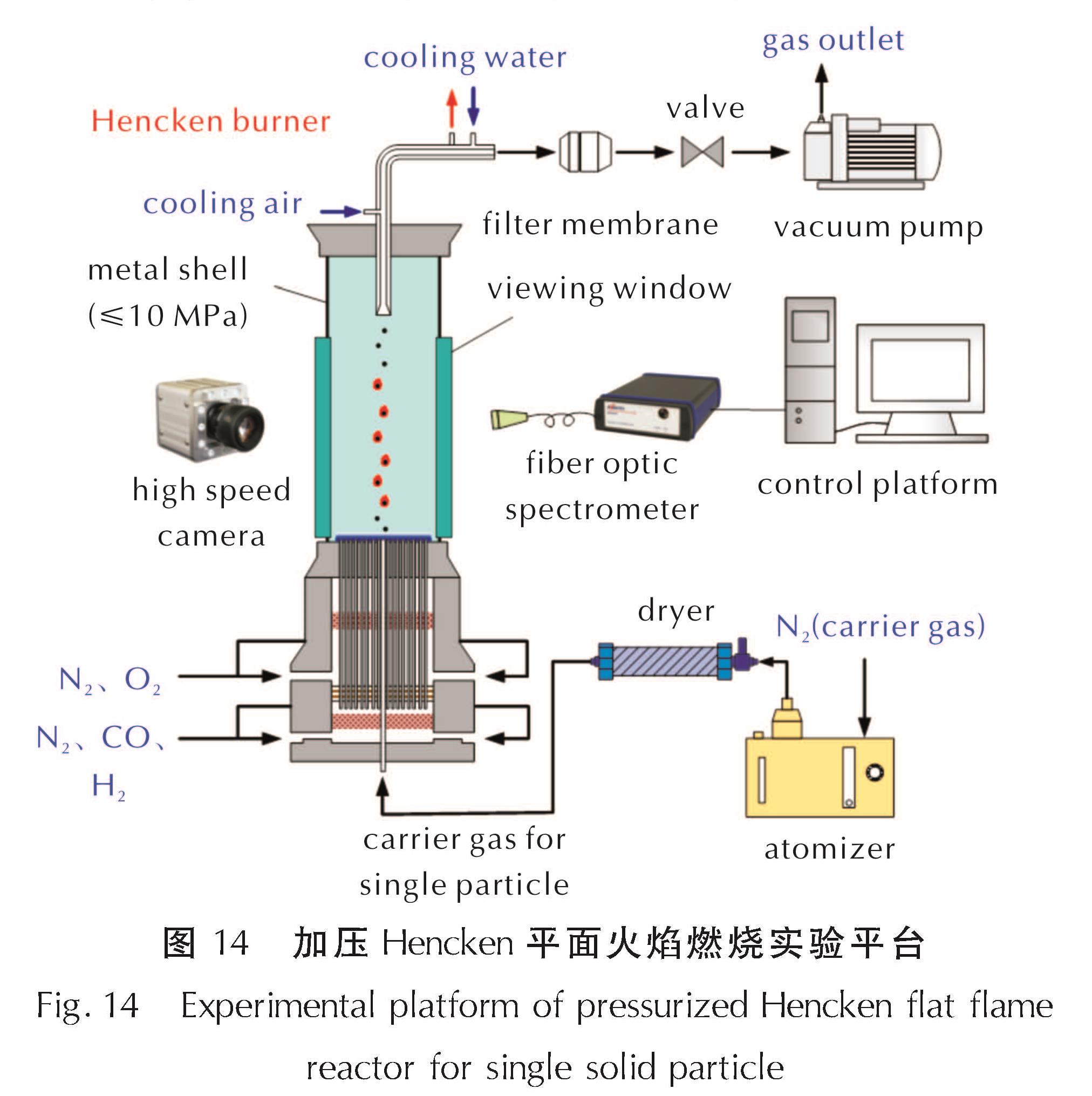
此外,国内众多高校科研机构均对基于平面火焰动态携带流的热气流点火技术有所研究与应用,包括国内西北工业大学[14]、国防科技大学[19]等,同时,西安近代化学研究所也搭建了如图 14所示的加压Hencken平面火焰燃烧实验平台,主要用于对含能材料单颗粒进行点火燃烧特性研究。
图 14 加压Hencken平面火焰燃烧实验平台
Fig.14 Experimental platform of pressurized Hencken flat flame reactor for single solid particle
根据上述研究内容,在固体含能材料的点火燃烧特性基础研究方面,基于静态样品气流点火和动态携带流点火的热气流点火技术已经被广泛应用且发展相对成熟。目前已有大量文献对固体燃料单颗粒的热气流点火技术进行了报道,然而上述研究内容主要集中在金属颗粒和煤粉颗粒两方面,缺少针对以RDX、HMX和CL-20等为主的单质含能材料单颗粒及复合含能材料颗粒采用动态携带流的相关研究,同时更缺乏含能材料单颗粒的燃烧动态演化过程及点火燃烧模型。固体含能材料单颗粒在动态携带流中的点火燃烧过程非常适合模拟固体推进剂中各组分颗粒的多相流动与反应过程。因而,十分有必要开展基于动态携带流点火技术的含能材料单颗粒点火燃烧特性与点火燃烧机理相关研究,能够为我国掌握固体含能材料的点火燃烧本征机理以及释能与控制规律提供重要的实验数据及理论基础。
![图1 用于固体火箭发动机的点火器[27]<br/>Fig.1 Schematic diagram of igniter used for solid rocket motor](2023年08期/pic02.jpg)
![图2 多分散含铝颗粒气溶胶的激光点火实验平台[58]<br/>Fig.2 Experimental platform of laser ignition for polydisperse aluminum-containing aerosol](2023年08期/pic03.jpg)
![图3 用于固体推进剂颗粒燃烧的激光点火实验系统示意图和实物照片[65]<br/>Fig.3 Schematic diagram and photo of the laser ignition platform for solid propellant](2023年08期/pic04.jpg)
![图5 聚光光热燃烧实验系统:(a)示意图;(b)聚光点火反应器;(c)温度测点[76]<br/>Fig.5 Experimental platform of concentrating photothermal ignition: (a)schematic diagram;(b)spotlight ignition reactor;(c)temperature measurement point](2023年08期/pic06.jpg)
![图6 微波点火对材料进行整体性加热与选择性加热[79]<br/>Fig.6 Principle of integral and selective heating of microwave ignition](2023年08期/pic07.jpg)
![图7 微波点火探针作用于Al/PVDF和Ti/PVDF薄膜后的点火效果[81]<br/>Fig.7 Effects of microwave ignition probe on Al/PVDF films and Ti/PVDF films](2023年08期/pic08.jpg)
![图8 固体燃料颗粒激波点火实验系统示意图[16]<br/>Fig.8 Experimental platform of shock wave ignition for solid fuel particles](2023年08期/pic09.jpg)
![图9 激波点火过程中的压力曲线与OH发射率曲线[98]<br/>Fig.9 Curves of pressure and OH emissivity during shock wave ignition](2023年08期/pic10.jpg)
![图 10 电感线圈导热点火实验平台与凝胶颗粒点火图像:(a)点火瞬间;(b)点火、燃烧和燃尽; (c)局部微爆炸;(d)爆炸碎片[42]<br/>Fig.10 Experimental platform of induction-coil-conduction ignition and images for gel particles: (a)ignition moment;(b)three reaction stages;(c)local micro explosion;(d)explosive fragments](2023年08期/pic11.jpg)
![图 11 用于固体燃料单颗粒加热点火的固定床反应器[103]<br/>Fig.11 Fixed bed reactor for solid fuel particles](2023年08期/pic12.jpg)
![图 12 预混气体燃烧形成层流火焰的平面火焰反应器:(a)实验系统示意图;(b)燃烧颗粒和平焰的光度照片; (c)示意图虚线区域中二维OH-LIF图像[107]<br/>Fig.12 Plain flame reactor with premixed gas combustion forming laminar flame:(a)schematic diagram;(b)photographs of burning particles and flames;(c)2D ON-LIF images in the dashed line area of the schematic diagram](2023年08期/pic13.jpg)
![图 13 单颗粒铁的燃烧强度变化与燃烧动态演化过程[109]<br/>Fig.13 Variations of combustion intensity and combustion evolution for single iron particle](2023年08期/pic14.jpg)